Prison Act, Section 18: voluntary isolation
Three SecondsPrison Act, Section 18: voluntary isolation is a protective procedure that places a prisoner in a separate prison unit at his request, without giving him the same status as someone in enforced solitary confinement. Its limits become central to Piet Hoffmann’s survival at Aspsås Prison: the move separates him from the larger prison population, but does not eliminate danger or give him control over the conditions of his confinement.
Purpose and legal distinction
The procedure is presented as a duty of the prison, not a favor that officials may grant or refuse at will. When Hoffmann explains that he has requested voluntary isolation, Lennart Oscarsson confirms that the prison must move him under Paragraph 18. The measure is therefore a formal response to a prisoner’s request for protection, rather than a punishment imposed for misconduct.
The distinction from enforced solitary confinement is explicit. Voluntary isolation under Paragraph 18 does not mean that a prisoner can order the authorities to place him in the prison’s solitary-confinement “hole.” That separate measure, associated with Paragraph 50, has different rules and conditions; it is not voluntary and must be imposed by a principal officer or by Oscarsson. The contrast marks two different exercises of authority: a duty to respond when a prisoner asks to be separated from other units, and an official decision to impose solitary confinement.
The danger that prompts the request
The procedure’s immediate context is the threat Hoffmann faces inside Aspsås Prison. He has entered the prison with a constructed criminal identity and deliberately established a visible presence in his unit. He studies the other prisoners’ backgrounds and positions himself where they will see him, while two men associated with Wojtek, Stefan Lygas and Karol Tomasz Penderecki, are meant to help him remove competitors and take control of the prison drug market. If his identity as Paula is exposed, those same men could become his executioners.
The ordinary unit has its own social tests as well as its formal routines. Hoffmann learns where to go and when the unit locks in, then makes a calculated display of confidence in the shared space. At supper, two older prisoners demand to see his papers; Lygas and Penderecki begin to intervene, but Hoffmann signals them to wait and handles the challenge himself. The exchange shows that a transfer into a new unit is also an entry into an informal order in which status must be established. Prison records and other documents have already circulated through Lygas and Penderecki, giving them material with which to support Hoffmann’s cover.
That cover does not make the unit safe. Hoffmann’s account of the danger is sharpened by his knowledge that exposure could make him a target throughout the prison. In his cell he takes precautions against an attack at the moment when staff cannot see or hear what is happening. When he later concludes that someone has discovered the truth, isolation becomes a way to reduce the distance between being threatened and being reached: in a prison, he cannot escape far, but he can ask to be moved away from the unit where the threat is concentrated.
Transfer and conditions
The transfer is organized as a security operation. Ten members of the prison riot squad arrive in helmets and shields, carrying sedatives. Six remain to discourage renewed violence, while four escort Hoffmann through the passages and down to Block C, with two officers in front and two behind. The procedure does not erase the prison’s control over his movement; it changes the unit in which that control is exercised.
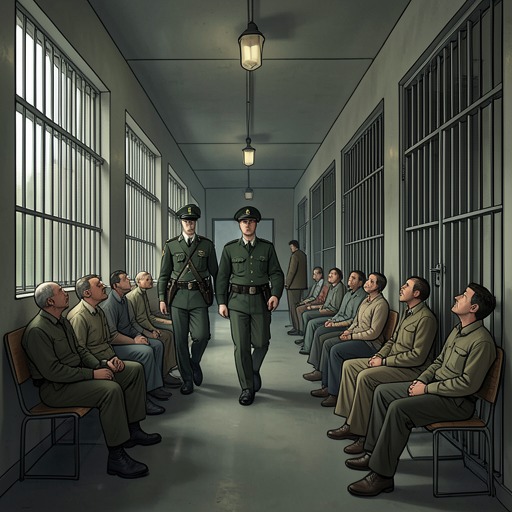
The voluntary-isolation unit contains sixteen cells and resembles an ordinary prison unit in its facilities: a staff room, television corner, showers, kitchen, and Ping-Pong table. Prisoners there can move around within the unit, but do not risk meeting prisoners from other units. That arrangement gives Paragraph 18 a practical, bounded meaning. It creates separation from the wider prison population without placing the person in a single cell or removing all contact with other prisoners.
Hoffmann’s actions after the move show how urgently he wants the authorities to respond to him. He asks to call the police and insists on his right to contact his lawyer and other approved numbers. He also makes repeated demands for attention and disrupts the cell and its furnishings. Oscarsson, who has been told about the disturbance, goes to see him. The scene makes the procedure’s administrative character visible: the move has taken place, but questions of access, communication, and what further restrictions can lawfully be imposed remain contested.
Protection and its limits
The unit offers Hoffmann distance from the prisoners he has left behind, not isolation from every possible threat. He recognizes that the people moving freely in the unit remain dangerous; moving prisoners away from other units has not separated them from one another. His discovery that one of the four men he regarded as protection has betrayed him further undermines the security he thought he had arranged. The evidence does not identify which man exposed him, but the betrayal changes the meaning of the transfer: the danger may have travelled with him, or may already be present among those sharing the unit.
Paragraph 18 is thus neither an escape from custody nor a guarantee of safety. It gives a prisoner a route to request separation and obliges the prison to act, while leaving the authorities in control of the unit and its boundaries. Hoffmann’s case tests the distance between a procedural safeguard and actual protection. The rule can move him away from one concentration of risk; it cannot make the prison an open route out, ensure that everyone in the new unit is safe, or substitute for the stricter and separately authorized conditions of Paragraph 50.